Your story is an important way to influence other congregations. Telling your story makes you a solar champion, building this growing movement by showing other congregations that it can be done.
Please join and contribute to this effort. We will list your name and picture of your solar array, and a sentence or two about your congregation.
The Unitarian Universalists of Central Oregon had great leadership and a very engaged congregation that made this project happen. Way to go UUFCO!
Ashland UMC pulled together a committed congregation to make their project work. Congratulations Ashland congregants committed to fighting climate change!
Molalla United Methodist received a grant from Cascadia Grants and Loans to make their solar project pencil out. Nice going, Molalla!
Temple Beth Sholom is always looking for ways to serve both its members and the broader Salem community. The MillieWatts project is named in honor of Millie Estrin, who was was a pillar of our community and an ardent environmentalist. In 2019 she, along with several other TBS members, spearheaded a successful grant proposal to PGE
ur green team has been educating our congregation about aspects of creation care. In March, 2025, an anonymous donor gave $200,000 worth of stocks, to be used for solar panels or batteries. The $200,000 gift could install enough panels to provide at least $14,000 worth of electricity annually for at least twenty-five years. The panels were installed in late 2025 and connected in February, 2026. On hearing of the gift, some members said they would like to donate for solar panels, too. The business office now accepts donations designated for that purpose. Our installation has the same effect on our atmosphere as planting thirty acres of oak trees or taking twenty-two pickup trucks off the road.
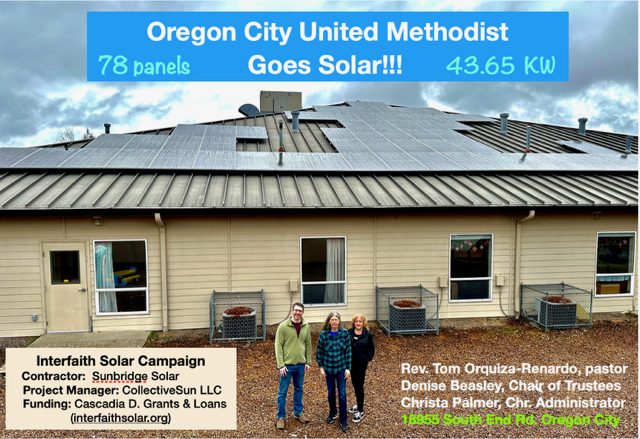
Oregon City United Methodist Church is covering nealry 100% of their electricity needs with this beautiful array!
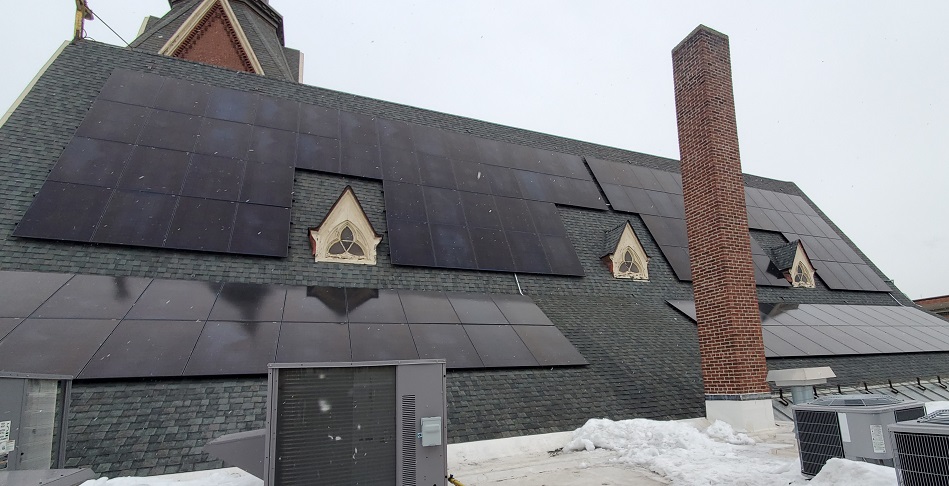
Main St. United Methodist Church, Nashua, New Hampshire
Main Street United Methodist Church in Nashua, NH has discussed a conversion to solar power for several years. In 2025, the church contracted with Revision Energy to install 128 56.32kW panels for an annual generation of 70,805 kWh. Upon approval of the project by the church council, a Solar Project capital campaign was initiated and all funds required for the project were raised. The system became operational on March 11, 2026.
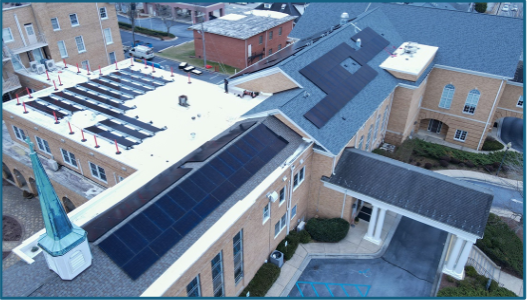
The Hendersonville FUMC Board of Trustees received a suggestion in 2021 from one of the trustees, Jim Kane, that the church should investigate the possibility of rooftop solar as a means of lowering energy costs and reducing emissions. The church buildings constitute about 66,000 sq. ft. and were consuming on average about $34,000 (367,000 kWh) in electric utility charges, plus another $18,000 (26,000 therms) annually in natural gas usage. After discussion among the Board and the congregation, proposals were sought from solar suppliers. Sugar Hollow Solar (https://www.sugarhollowsolar.com/) of Asheville, NC, made a presentation in July of 2022 for a plan to install a 137 kW rooftop system at a cost of about $323,000. The array was projected to produce about 167,000 kWh of electrical energy annually and would comprise 349 Tesla-395H panels. Each panel would have a power rating of 392 watts. The design would provide about 50% of the facility’s electrical requirements. After discussion, the Sugar Hollow plan was accepted and a contract was signed. The potential for rebates was an important consideration in the decision to embark on the project. At that time the regional utility, Duke Energy Carolinas, offered a rebate of $7500 per 10 kW of solar, up to a limit of 100 kW. A portion of the rebate program was set aside specifically for non-profits. Because the church has two meters, and thus two solar installations, the total Duke rebate would be about $100,000. In addition, the federal Inflation Reduction Act (IRA) direct-pay reimbursements had recently become available for non-profits. The IRA offered a potential 30% reimbursement of the project costs. These inducements served to make the project more feasible financially. With the two reimbursements, the potential payback time was estimated to be about 12 years. The panels were installed on seven roof surfaces of the church complex in Spring of 2023. Six were set at various angles, and one was flat. The system went online in May of 2023. The system is controlled by the SolarEdge monitoring program (https://www.solaredge.com/us/products/software-tools/mysolaredge), which enables real-time monitoring of its performance. The solar output is net-metered, with no battery storage. Any excess output goes to the grid, for which the utility compensates the church by reducing the monthly charge for grid-supplied energy. The 137 kW solar system is expected to produce about 167,000 kWh annually. At that rate, the system’s clean energy production replaces fossil fuel-generated electricity that would emit 92,400 pounds (46 tons) of CO2 equivalent to the atmosphere. This reduces the congregation’s grid electricity carbon emissions by over 50%. The total emissions (electric + natural gas) are reduced by about 20%. The reductions are equal to the carbon emitted by 104,000 miles of automobile travel, or the charging of 5,100,000 smartphones. It is equivalent to the planting of 50 acres of trees.